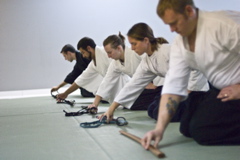
Iaido, the Japanese art of drawing the sword, is considered an art of
the aristocracy because, in feudal Japan, swords could only be carried
by the upper class. The art was created in response to
specific
conditions: when samurai were attacked while their swords
were
still sheathed. The key concept in Iaido is that the draw and
first cut must occur simultaneously and quickly. Many unique
cutting motions were created to make this possible. Practice
is
very precise and demands great concentration.
Iaido is a highly traditional art. Its forms are hundreds of
years old, having been passed down from instructor to student since
their creation. It is also traditional in the sense that it
has
no modern applications. Since there is no practical purpose
for
sword fighting methods in modern times, there is no reason to "update"
the forms, or to make the art more effective for self-defense.
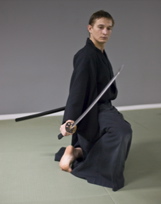
The physical practice of Iaido includes drawing, parrying and cutting
motions, as well as various methods for returning the swords to the
scabbard. The majority of practice time is spent studying
pre-arranged forms, called kata. The motions are designed as
defenses against specific attacks by an opponent, and each form teaches
several principles of correct sword handling.
In addition to being a historical art, Iaido is, like other martial
arts, a method of spiritual development. It is one of the
best
arts for conveying the concepts taught in zen. Many practice
Iaido as a second martial art, to compliment the more physical practice
styles of karate, judo or jujutsu.
Muso Jikiden Eishin-Ryu Iaido is the
second oldest extant martial arts style in
Japan. Eishin-Ryu Iaido ranks can be certified by the
Shudokan
Martial Arts Association (SMAA) and the
Kokusai Budoin, IMAF.
For more
information, please contact
Nickalus
Suino Sensei at
info@japanesemartialartscenter.com.
For
Private Lessons in Muso Jikiden Eishin-Ryu Iaido in the
Ann
Arbor, Michigan or Lansing, Michigan area, please contact Dan Holland
Sensei at
dholland@itama.org.